The Mississippi Legislature is preparing for what could be a contentious redistricting process and preliminary data already shows that many of the state's 174 legislative districts will be redrawn.
The census data released in April for apportionment purposes showed that the state lost 3,383 residents as compared to the 2010 census, the first population loss in 60 years.
According to these numbers, each of the Senate's 52 members will represent about 56,998 residents, less than 2010 when each senator represented 57,063.
Click on Title To Read Document
In the House, each of its 122 members will represent about 24,294 people.
The requirement in the Mississippi Constitution is that legislative boundaries be contiguous and state law requires them to be compact and cross as few political boundaries as possible. The Legislature will pass a joint resolution with the district lines that isn't subject to a veto by the governor.
The biggest winners in terms of added representation, according to preliminary population estimates that the U.S. Census Bureau performs annually, were:
- The three coastal counties of Hancock, Harrison and Jackson.
- Lafayette County.
- Suburban counties such as DeSoto (Memphis, Tennessee), Rankin and Madison counties (Jackson) and Lamar County (Hattiesburg).
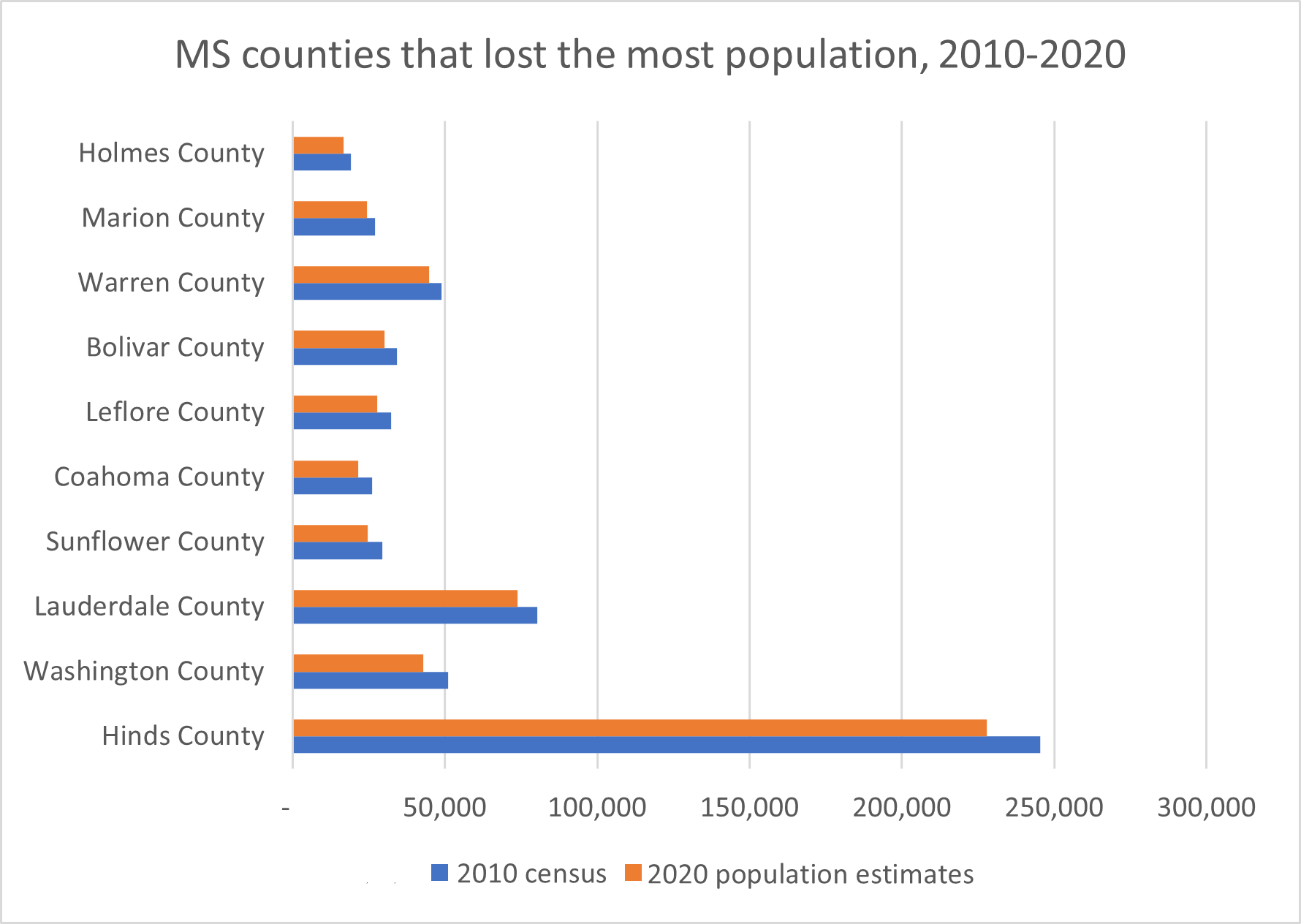 The biggest loser was Hinds County, which lost 17,319 residents compared to the 2010 census, a loss of 7.6 percent of its population. Madison and Rankin counties took advantage of the emigration, growing by 10.92 percent (11,668 new residents) and 9.21 percent (14,358 new residents) respectively.
Five Delta counties (Washington, Sunflower, Coahoma, Leflore and Bolivar) lost a combined 26,000 residents in the last decade. Sixty five of the state's 82 counties lost population while only 13 had a gain of 1,000 or more residents.
Another county that lost more than 6,000 residents was Lauderdale (8,300 residents or a 8.83 percent loss).
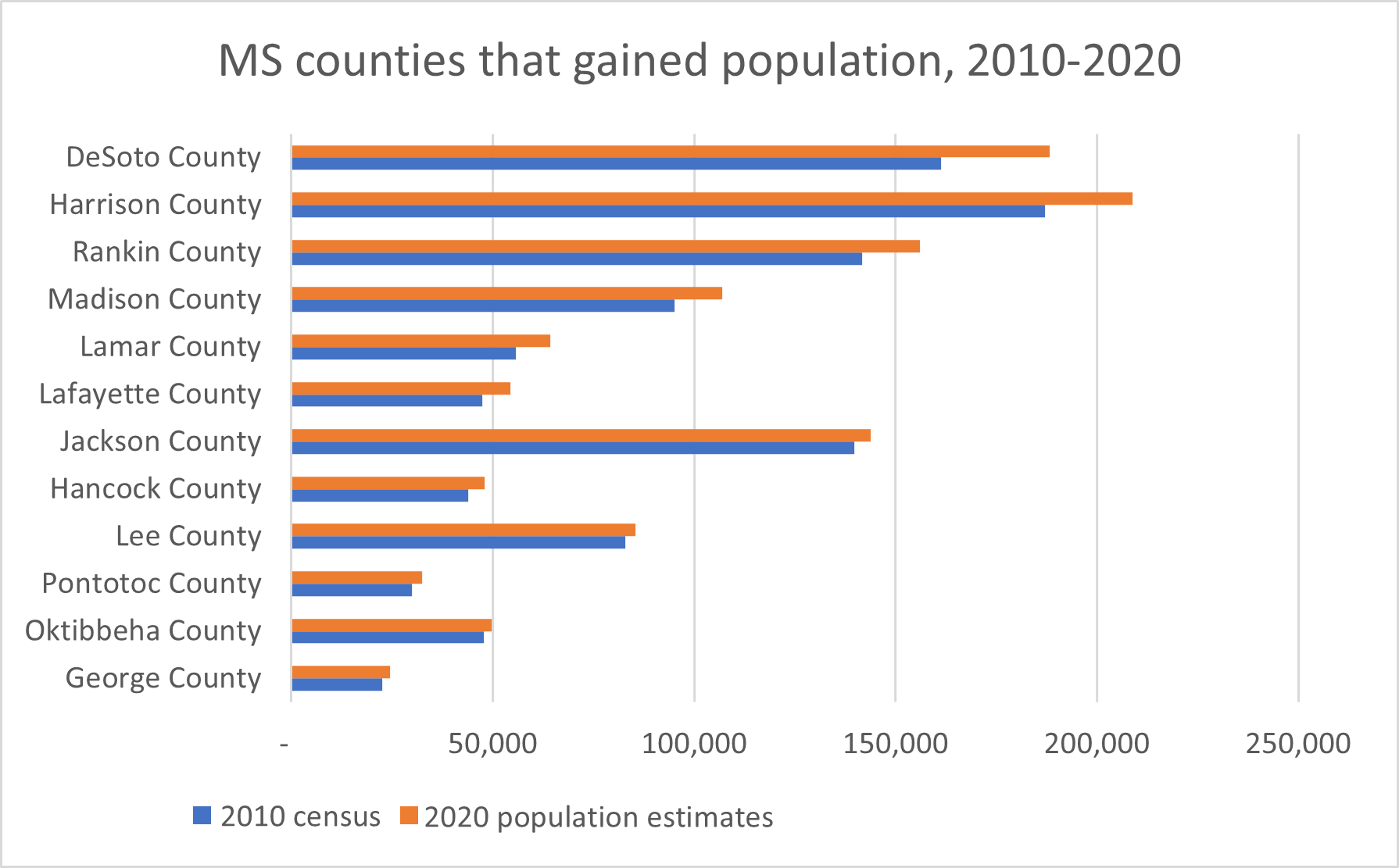 DeSoto County remains the fastest growing county in the state, with 27,023 new residents (14.35 percent gain from 2010. That would be a new House district just in the county alone.
The Coast is becoming a major population center for the state, with the three coastal counties gaining 29,901 in new population in the last decade, with most of that in Harrison County (21,696 gain or nearly a new House district).
LaFayette County had a population jump of 12.97 percent or 7,057 residents, while Lamar County gained 8,507 new residents for an increase of 13.26 percent.
The population loss could be even greater, considering that the 2020 estimate of population has 2,872 residents more than the state total in April's population number.
The in-depth data from the U.S. Census, constitutionally mandated every 10 years, will be available on August 16.
The joint redistricting committee will hold nine hearings statewide, with all starting at 6 p.m. All will be livestreamed on the Legislature's Youtube channel.
- August 5 – Meridian Community College at the McCain Theater.
- August 6 – Itawamba Community College's Belden Center in Tupelo.
- August 9 – Northwest Community College's Haraway Center in Senatobia.
- August 11 – Mississippi Valley State University's William A. Butts Social Science Building in Itta Bena.
- August 12 – Mississippi State University's Hunter Henry Center in Starkville.
- August 16 – Alcorn State University's business school auditorium in Natchez.
- August 18 – Mississippi Gulf Coast Community College's Harrison County campus fine arts center in Gulfport.
- August 19 – The University of Southern Mississippi's Joe Paul Theater at the Thad Cochran Center in Hattiesburg.
- August 23 – at the state Capitol, room 216.