(An account of a short-term missionary’s adventures installing wells in Africa. First of eight parts.)
In flight from Lilongwe, Malawi; 12:17 p.m.
I just made my last body-pounding drive on bad roads (more on that later) to the airport for the return flight home, and I’m finally settled into my steerage-class seat and at the keyboard of my iPad undertaking the challenge of capturing the three-week experience of delivering clean water to the Malawians. How to approach this is a considerable challenge, given the impeding effect of my aging and far-from eidetic memory.
I am returning from Africa having served as a volunteer for Marion Medical Mission (https://www.mmmwater.org) based in Marion, Illinois. Since 1990 MMM has installed more than 50,000 wells (4025 more this year), bringing clean water to over five million people. The effect of that effort is seen in government data reflecting far fewer cases of water-borne disease such as cholera and E. coli in areas where the wells are installed.
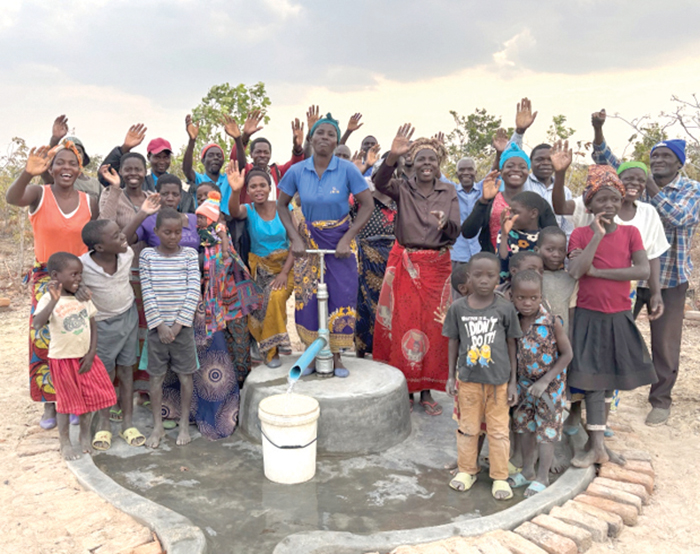
Each well costs only $450, and that small sum brings water to roughly 100 people for many years – people who have never had fresh water. The look of awe and gratitude on the faces of all, young and old, when that first pump gushes clear and cold can’t be described.
MMM’s well effort in Africa serves four countries (Malawi, Zambia, Tanzania and Mozambique) and is administered by Africans for Africans and uses locally produced material. MMM has only one paid employee in America and dozens of African staffers. Its production factory in Malawi makes the well-pumps from galvanized and polymer parts which are cut, drilled and tapped by local employees, and produced at a prodigious rate.
The wells are dug by village volunteers who are assisted by local MMM technical crews – all Africans. The raw material for the ‘pit’ lining each well consists of bricks made onsite. After each well is dug and capped by a two-meter apron and well mount, the final pump installation is completed by African pump crews assisted by MMM American volunteers who drive, haul material and take detailed technical information. Each well is dedicated in a joyful ceremony as it pumps out clean and pure water. Written on each wellhead is ‘Glory to God’ in English and the local language, usually Chichewa. God is indeed glorified.
I asked my field officer once how MMM finds water sources underground, assuming the use of a sophisticated machine. He said “fig trees.” “Huh?” I asked. “Vigorously growing fig trees indicate that a water source is very near. We look for them, then dig there – we have few dry holes.” Note to preachers and Sunday School teachers: Work that tidbit into your next ‘fig tree’ lesson.
As I cruise at 37,000 feet over the dusty sub-Saharan landscape below me, I wonder how to capture the experience of the last few weeks. I’ll write about the many manifestations of God’s provision in the daily reminders of His grace and power.
I’ll write about the many challenges of life in rural East Africa for visitors. Here are some snippets: The language - since my hearing is ‘subpar,’ my complete failure to detect consonants, combined with local accents one can only describe as Caribbean, contributed to a near-constant hilarity - usually at my expense. The food - the bread is similar in texture to the styrofoam ice chests on sale at American convenience stores. The lodging - there was no toilet seat or running water in various hotels, and often no electricity. The animals – live chickens were treated as roughly and casually as sacks of peanuts, vigorously squawking at all such treatment. The interactions - ‘Mzungu!’ - white person - they shouted with joy when I drove or walked by.
I’ll write about the beautiful Malawians. The traditional values – children of unwed parents are almost unheard of; marriage is esteemed. The poverty - $6.00 a day is a ‘decent wage.’ The workmen requested our empty water bottles for their families and expressed deep appreciation when we gave them. The adaptability – the McGyver-like skill each common working man exhibited in solving any problem, a function of adapting to a world of no training, few tools, fewer supplies.
Much more to come.
If you, gentle reader, want to experience the joy of providing clean water to a grateful village, visit the Marion Medical Mission website (https://www.mmmwater.org) to make that happen. For just $450 you can build a well for more than 100 people.
Up next: God’s providence is all around.
Jeff Weill is a senior status judge living in Jackson.